
← The Journal May 29, 2026
The Most Powerful Marketing Development Tool Is Microsoft Word
The tool that wins the deal in B2B healthcare is already open on every desktop: the document. A field note on making proposals, one-pagers, and SOWs close.

Every healthcare group we talk to eventually asks some version of the same question: what should we be spending on marketing. They mean a tool. A CRM, a marketing automation platform, a new website, a retainer with an agency that promises pipeline. The premise underneath the question is that growth is a technology problem waiting for the right purchase.
It usually is not. In B2B healthcare — practice management, teleradiology coverage, the kind of operational services Yellowcross sells and the kind our clients sell to hospitals and groups — the deal is won or lost on a document. A proposal. A one-page overview. A scope of work. The single most powerful business development tool in the building is already open on every desktop, and it is Microsoft Word.
This is not nostalgia and it is not a knock on real marketing technology, which has its place. It is an observation about where leverage actually sits in a long-cycle, high-trust, relationship-driven sale. The buyer is a medical director, a CFO, a practice administrator. They are not converting off a landing page. They are reading a document — closely, skeptically, often out loud in a room with other people — and deciding whether you understand their problem well enough to be trusted with it.
The Document Is the Sale
In a transactional business, marketing’s job is to generate volume at the top of a funnel and let the funnel do the work. In healthcare services, there is barely a funnel. There is a small number of consequential conversations, and in almost every one of them a document carries the weight.
The proposal is where the buyer decides whether you actually heard them. The one-pager is what gets forwarded to the person who wasn’t in the meeting and who will quietly veto you if it reads like a brochure. The SOW is where trust either survives contact with specifics or quietly dies. None of those moments happen on a website. All of them happen in a document that someone on your team wrote, and the quality of that writing is doing more selling than any campaign you could buy.
When a deal stalls, groups reach for a new channel. More often the problem is that the document asked the reader to do too much work to figure out what was being offered, what it cost, and why it was the obvious choice. That is not a technology gap. That is a writing gap, and writing gaps do not get fixed by buying software.
Why Clear Beats Clever
The instinct, when a document matters, is to make it impressive. More logos, more capabilities, more proof points, a deck instead of a page. The result is a document that performs effort and communicates nothing. A busy administrator opens it, cannot find the one thing they need in the first fifteen seconds, and sets it aside to “review later,” which is where proposals go to die.
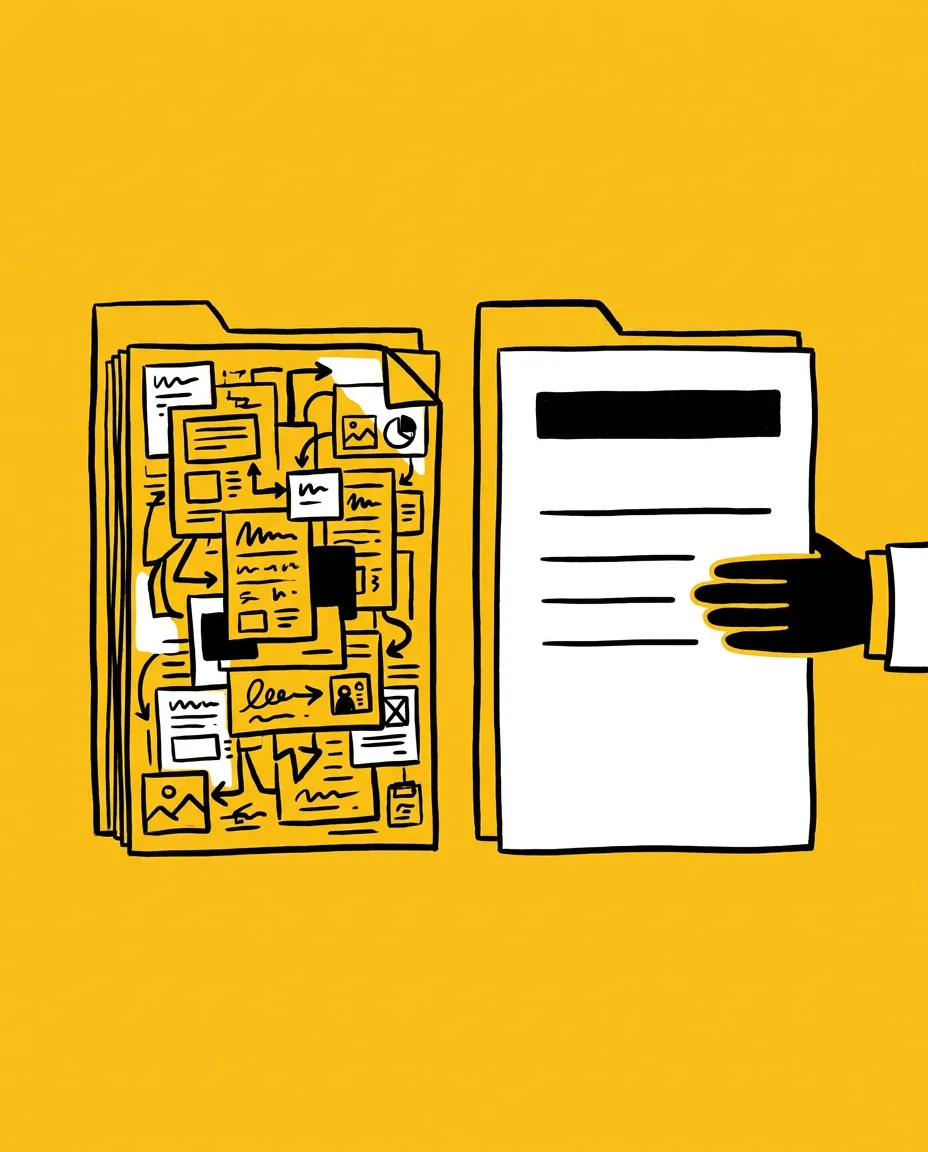
The documents that win do the opposite. They say what the service is in a sentence a non-expert could repeat. They state the price without making the reader hunt for it. They name the specific problem the buyer described, in the buyer’s own words, before describing the solution. They have white space, because white space is what tells a reader the author knew what to leave out. Clarity reads as competence. If you can explain the offer simply, the buyer believes you can deliver it simply, and in operations that belief is the entire purchase.
This is the part that makes Word the right tool rather than a fancier one. The blank page is honest. It does not let you hide a muddy offer behind a template or a transition animation. If the value is not clear in plain text, it is not clear, and the design was only ever going to disguise the problem long enough to lose the deal.
What Actually Makes a Document Close
A few habits separate a document that gets read to the end from one that gets skimmed and shelved.
Lead with the reader’s problem, not your company. The first paragraph should prove you understood what they said, not recite your founding year. A buyer who sees their own situation described accurately in the opening lines will read the rest generously.
Put the offer and the price where they can be found in seconds. Make the cost easy to locate, not buried on page nine. Hiding the number reads as a lack of confidence in it.
Cut every sentence that is there to sound credible rather than to inform. Jargon is not authority. The credible document is the one a smart outsider could follow without a glossary.
Use structure the eye can scan — short paragraphs, clear headings, a single idea per section. Most proposals are read in a hurry by someone deciding whether to keep reading. Reward that reader and they keep going.
Make it forwardable. The person you met is rarely the only decision-maker. Write the document so it still makes the case when it lands, with no cover note, in an inbox you will never see.
None of that requires a tool you do not already own. It requires deciding the document is the product of the sale and treating the hour you spend on it as the highest-leverage hour in your week, because it is.
The Discipline, Not the Software
The point is not literally that you must use Microsoft Word. Use whatever opens a blank page. The point is that healthcare groups routinely overspend on marketing technology to solve a problem that is really about the clarity of a handful of documents, and they under-invest in the one skill — plain, structured, reader-first writing — that moves every deal they actually care about.
The next time growth feels like it needs a purchase, open the last proposal you sent and read it as the buyer would, in a hurry, looking for a reason to say no. If it gives them one, no platform will save it. If it is clear, specific, and easy to forward, you already own the most powerful business development tool there is.
This is the kind of unglamorous, high-leverage operational work Yellowcross does with the healthcare groups we partner with — getting the document, the offer, and the message clear before anyone spends a dollar on a channel. If your proposals are not closing the way the work deserves, that is a conversation we are built to have. Start at yellowcross.com, or read the companion piece on the broader challenge most groups face: Building a Radiology Practice: Overcoming the Business Development Challenge.
Want to talk?
Have a healthcare practice that needs help?
Reach out — we'll respond personally and confidentially.
Contact us