
← The Journal June 19, 2026
The 18-Month Consolidation Window in Radiology
Big tech, retail health, and private equity are converging on imaging at once. Independent radiology groups have a closing window to choose their own future.
Radiology has been told it is about to consolidate every year for the last decade. The boy has been crying wolf for so long that most group leaders have stopped looking up. This is the year to look up.
Three forces that did not exist in their current form during the last false alarm are now converging on imaging at the same time. Amazon has stood up telehealth in all 50 states and merged it with One Medical’s 188-plus clinics. CVS Health is running 9,900 retail locations with expanding virtual care capabilities and has spent the last three years building the rails to extend into imaging-adjacent services. Private-equity deal pace in radiology has nearly doubled, and strategic buyers — health systems acquiring directly — overtook financial buyers in 2023 and 2024. No single platform yet controls more than 20 percent of the addressable market. That is what an industry looks like in the eighteen months before it is reshaped.
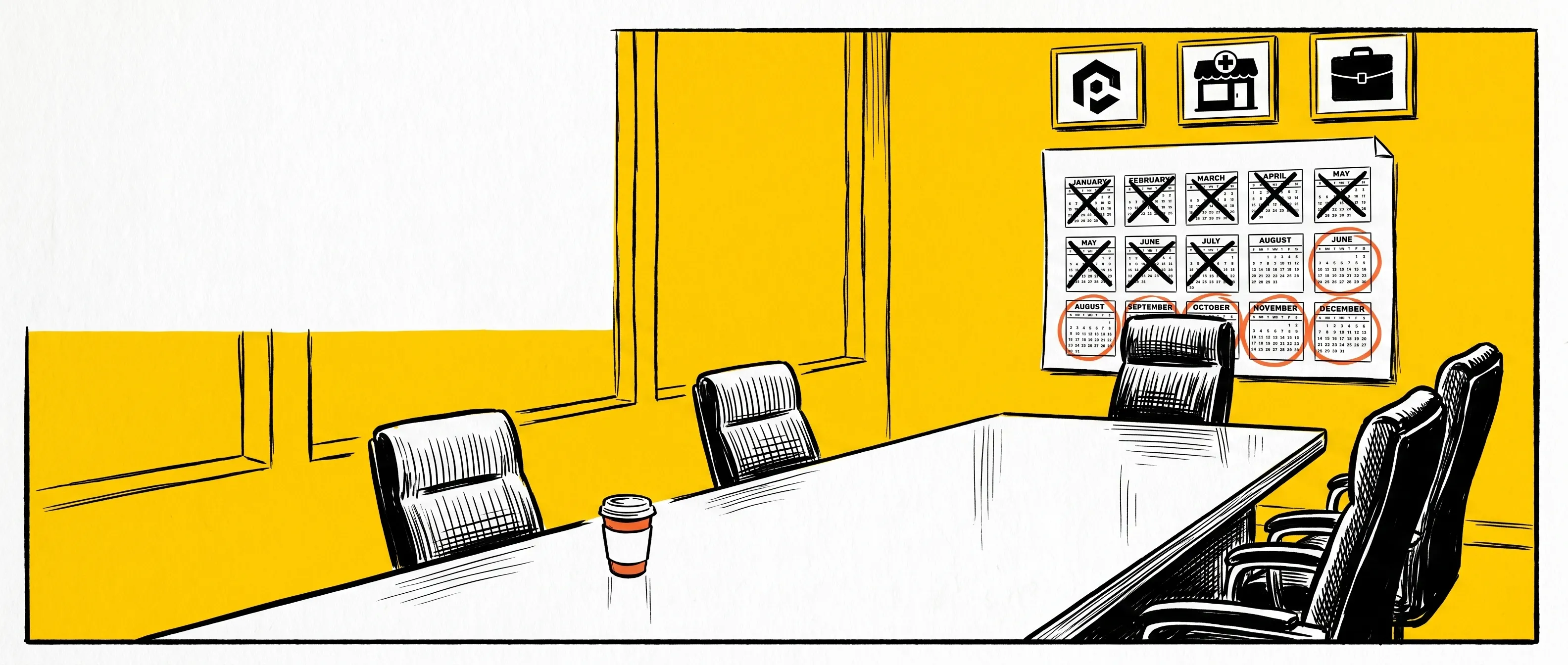
The window for an independent radiology group to choose its own future closes inside that eighteen-month frame. After the frame closes, the choice gets made by someone else, on someone else’s terms, at someone else’s valuation. This is not a doom forecast. It is a structural reading of where the consolidation curve actually is right now.
The Three Forces and Why They Compound
Big tech is the headline but it is the least interesting of the three on its own. Amazon’s value to imaging is not that they will start interpreting CTs — they will not. The value is the distribution layer: a fifty-state telehealth footprint that can route patients into imaging orders, plus a primary-care chassis through One Medical that turns those orders into a captive volume stream that has to go somewhere. Whoever that somewhere is, by contract, gets a structural advantage in any market where Amazon has presence.
Retail health is the same logic from a different vector. CVS, Walgreens-adjacent imaging partnerships, and the surviving subset of retail-health entrants have spent the last cycle building toward a single thesis: that patients will choose the cheapest, closest, most convenient site of care for routine imaging, and that the hospital outpatient center is no longer the default. Whether that thesis is fully correct does not matter for our purposes. It matters that the entrants are continuing to commit capital to it, which means independent imaging centers are about to face a different competitive set than the one they have been pricing against for the last fifteen years.
Private equity is the force that actually closes the window. PE has discovered radiology in the way it discovered dermatology in 2015 and gastroenterology in 2018. The pattern is identical. A handful of platform groups assemble; they acquire mid-size groups at premium multiples for the first eighteen to twenty-four months; the multiples compress as the supply of acquirable groups thins; and the late entrants get either a worse deal or no deal. The groups that move first inside that window choose their partner. The groups that move late get whatever partner is left, at whatever multiple is left.
The reason the three forces matter together rather than separately is that they pull from opposite ends of the value chain. Big tech and retail health are pulling on demand. Private equity is pulling on supply. The independent group sitting in the middle has decisions to make about both at the same time, and historically those have been two different conversations on two different timelines.
Why “We Have Heard This Before” Is the Wrong Answer
The honest reason radiology consolidation predictions have failed for a decade is that imaging is a difficult business to roll up well. Reads are not commodity. Subspecialty depth varies. Referral relationships are local and personal. Hospital contracts are sticky. A PE shop that buys a generalist group and tries to extract synergies the way it would in a dental DSO usually discovers that radiology does not behave that way.
But two things have changed since the last cycle that should be taken seriously. The first is that radiology AI has begun to do real work in a handful of workflow slots, which means the read-volume-to-radiologist ratio is no longer fixed in the way it was five years ago. A roll-up that bets on rising effective output per radiologist now has a math story that did not exist before. It may still be wrong. It is no longer obviously wrong.
The second is that hospitals themselves have moved. Pandemic-era valuations collapsed. Independent practice has fallen from 60 percent of physicians a decade ago to 26 percent today, per the AMA. Strategic buyers — health systems acquiring radiology groups directly rather than contracting with them — have overtaken financial buyers in M&A volume. When the hospital itself is the acquirer, the group’s negotiating leverage is different than when the acquirer is a PE platform with seven or eight other groups already on the books.
The combination of “AI changes the unit economics” and “hospitals are buying directly” is what makes this cycle different from the last three. Either one alone could be absorbed. Together they remove the two reasons radiology has been resistant to consolidation, and they remove them at the same time.
What Happens to Groups Inside the Window
Three group profiles survive this cycle intact. The first is the operationally tight, subspecialty-credible group that has invested in workflow, integration, and customer-side service levels — not because they were trying to be acquired, but because they were trying to be a good vendor. These groups get the cleanest exits, on their own terms, at the best multiples, because every PE shop in the deal flow can see that the operating model already works.
The second is the group that has chosen a sharp positional niche — pediatric imaging, breast imaging, complex MSK, a specific geography no roll-up wants to bother with — and built defensible referral networks inside that niche. These groups do not necessarily exit. They keep running. They are too small to be worth the roll-up’s effort and too embedded in their referrer base to be displaced.
The third is the group that has already aligned with a strategic — usually the health system that is its largest customer — and converted what was a contractor relationship into something closer to a joint venture or an employment arrangement before the acquisition pressure arrived. These groups trade some independence for a position inside a strategic that is itself going to be a consolidator. They lose the option to exit but they remove the risk of being absorbed on bad terms.
The profile that does not survive the cycle intact is the generalist mid-size group with diffuse contracts, weak subspecialty depth, no operational story to sell to a buyer, and no strategic positioning of its own. That group reaches the back end of the eighteen-month window and discovers that the platform groups have already absorbed the comparable groups, the multiples have compressed, and the hospital partners have already started bringing services in-house. That group sells late, at a worse multiple, into a thinner buyer pool, or it does not sell at all and gets the slow version of what RAS got the fast version of a decade ago.
What a PE Buyer Will Ask You
If you want a useful exercise this quarter, sit down and write the answers to the questions a PE buyer is going to ask, before they ask them. The list does not vary much.
What is your three-year revenue and EBITDA trajectory by customer, and what is the concentration on your top three? What is the subspecialty mix of your reads and what does your bench depth look like by modality? What is your turnaround time by study type and how does it compare to the contractual SLA? What is your radiologist retention and what is the average tenure? What is your IT stack and how much of it is owned versus contracted? What contracts come up for renewal in the next twenty-four months and what is the renewal risk profile?
If you can answer those crisply, you control the conversation when the buyer arrives. If you cannot, the buyer controls the conversation, and the answers — written quickly under deal pressure, by an investment banker who is not in the room with your operations team — will not flatter you.
Yellowcross’s Read on the Window
We do not think every independent radiology group should exit. We think every independent radiology group should make an active choice in the next eighteen months between three postures: prepare to sell on your own terms, double down on a defensible niche, or align with a strategic partner before the absorption pressure arrives. Drifting is the fourth option and it is the one the next cycle is going to punish.
If you want to think through which posture fits your group’s actual operational reality, that is a conversation we are glad to have. Start at yellowcross.com. The companion read on what happens when a 97-year-old practice misreads the consolidation moment is here.
Want to talk?
Have a healthcare practice that needs help?
Reach out — we'll respond personally and confidentially.
Contact us