
← The Journal June 12, 2026
B2B Beats B2C in Telemedicine: The Unit Economics That Decide Who Survives
Enterprise telemedicine and consumer telehealth are two different businesses. Most failed unicorns picked the wrong side. Here is the math, and the body count.
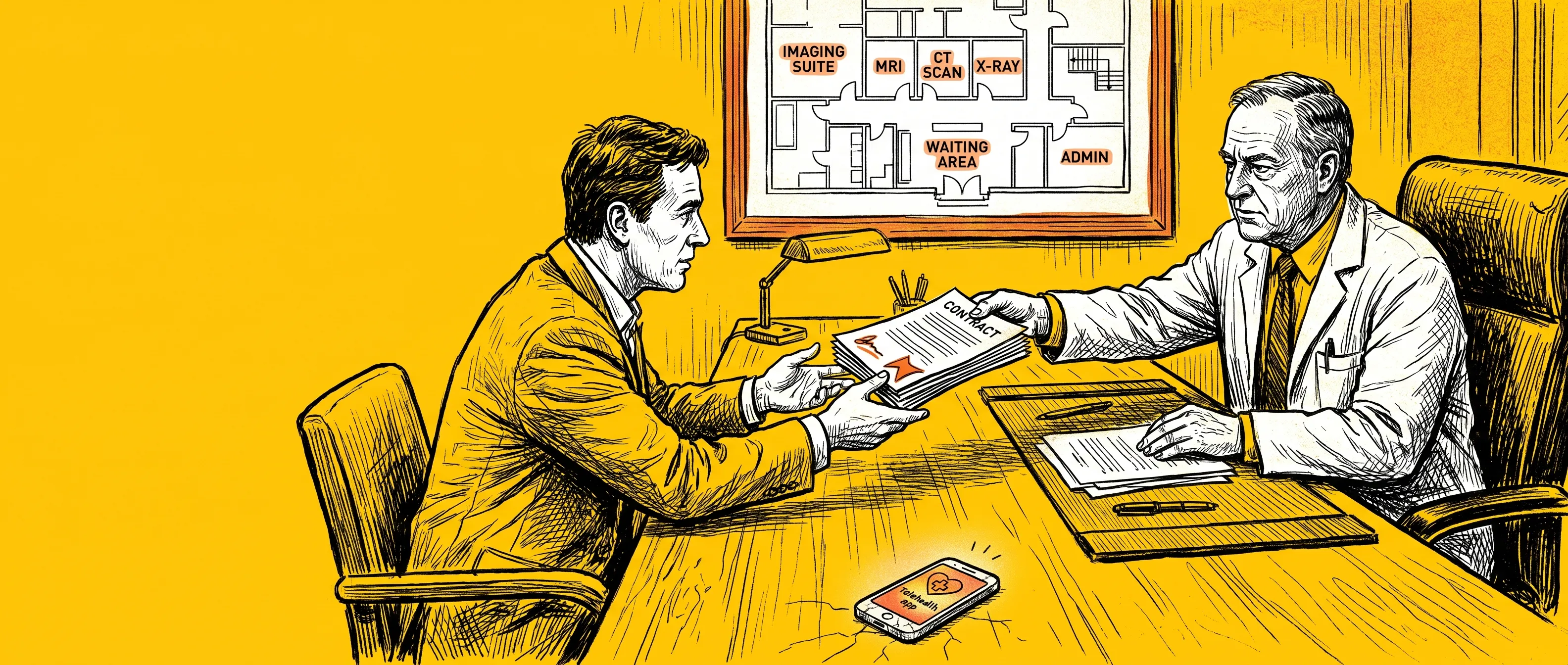
There is a habit in digital health press releases of treating “telemedicine” and “telehealth” as if they are the same thing. They are not. They are two businesses with two different customers, two different sales cycles, and two different margin structures, and the gap between them is wide enough that most of the spectacular failures of the last five years can be explained by founders and boards pretending the distinction did not exist.
The shortest version is this. Enterprise telemedicine contracts run $100,000 to $2,000,000 a year, take six to eighteen months to close, and produce 40 to 55 percent operating margins once you have your infrastructure right. Consumer telehealth visits run $35 to $150, have to convert immediately, and produce 15 to 25 percent margins on a good day. Same technology. Different business. Different fate.
The companies that ran into the wall in 2023 and 2024 were almost all consumer-side. The ones still standing — and the ones that pivoted in time — are almost all enterprise-side. That is not a coincidence and it is not a temporary state of affairs. The math is structural.
The Body Count Is Mostly One-Sided
Roll the list. Babylon Health went from a $2 billion valuation to bankruptcy in roughly 24 months. Forward shut down overnight in November 2024 after raising more than $650 million. UnitedHealth quietly closed Optum Virtual Care after three years. Walmart Health exited telehealth entirely in April 2024 and then exited primary care a few weeks later. HealthSpot — the retail-kiosk “doc in a box” — burned through $40 million by 2015 chasing the same consumer thesis. CarePoint filed for bankruptcy in 2016 after raising $16 million while trying to straddle both sides at once.
None of those companies died of bad technology. Babylon’s app worked. Forward’s clinics were beautiful. Walmart had distribution most enterprise vendors would commit minor crimes to access. They died of a unit-economics problem. They were selling $50 transactions to consumers who were already getting $0 telehealth from their insurer, in a market where Amazon, CVS, and Teladoc could absorb losses for years.
Meanwhile the enterprise side kept compounding. TeleSpecialists grew from a $225,000 line item to $50 million serving 175-plus hospitals. Teladoc — which itself pivoted from B2C to B2B in 2005 — built a $2.4 billion revenue business. American Well did its own consumer-to-enterprise pivot and reached IPO on the strength of it. The pattern is not subtle. The companies that are still operating in 2026 are the ones whose customers are health systems, not patients.
Teleradiology has been the canonical example of the enterprise model for thirty years, which is why nobody in our corner of the industry is surprised by any of this. We were B2B from the first day NightHawk turned on a workstation. We sold uninterrupted sleep for on-call radiologists and zero-delay trauma reads for emergency departments. The hospital wrote the check. The patient never saw the invoice. That is what enterprise looks like.
Why the Margin Gap Is Structural
The reason B2B telemedicine produces 40 to 55 percent margins and B2C telehealth produces 15 to 25 is not a function of effort or execution. It is a function of three things the consumer model cannot fix.
The first is customer acquisition cost. Acquiring a hospital contract is expensive in absolute dollars and slow — six to eighteen months of relationship work, RFPs, pilots, security reviews — but the contract that comes out the other end is worth $250,000 to $1 million in switching costs once it is signed, lasts three to five years, and renews at roughly 95 percent. Acquiring a consumer is cheap per head and fast, but the average consumer telehealth user churns at 50 to 70 percent a year and the lifetime value rarely covers paid-acquisition costs in any market where Amazon and CVS are also bidding on the same keywords.
The second is what you are actually selling. Hospitals do not buy technology. They buy solved problems — overnight coverage, stroke alerts that beat the door-to-needle clock, second-opinion workflows that reduce malpractice exposure, subspecialty reads that their own staff cannot cover. The product is the outcome. The technology is invisible. Consumer telehealth, by contrast, has to win on user experience and convenience against products users can already get for free or near-free through their employer benefits, and that race is unwinnable for a venture-funded entrant.
The third is the cycle itself. An eighteen-month sales cycle is a feature, not a bug, if your contract value justifies it. It selects for buyers who are serious, structures the deal around real integration, and creates moats that are very hard to displace once you are inside. The same eighteen-month cycle is fatal if your average contract is worth less than what it costs to close. HealthTap could not survive enterprise sales cycles on consumer pricing. Nobody can.
The Tell That You Picked the Wrong Side
Here is the diagnostic I use when a digital-health founder asks me to look at their model. If your CTO is being asked to optimize for HIPAA, high availability, and enterprise integration, you are B2B. If your CTO is being asked to optimize the user-acquisition funnel, you are B2C. If the same company is asking for both, somebody on the team has not made the strategic choice yet, and that company is going to spend two years burning cash discovering which one it actually is.
That is not a hypothetical. In 2019 a well-funded digital-health startup burned through $50 million in eighteen months building a B2C platform while pitching it as B2B telemedicine to hospital systems. Excellent technology, experienced leadership, strong board. The vocabulary mismatch killed them. Hospital procurement teams saw a consumer app and walked. Consumers saw enterprise pricing and walked. The product was fine. The strategic identity was not.
Radiology groups making investment decisions in 2026 should run the same diagnostic on themselves. If you are spending capital on a patient-facing direct-to-consumer offering — second-opinion portals, retail self-pay imaging interpretation — you are not in your historical business anymore. You are competing against retail-health entrants whose unit economics are structurally hostile to yours. That can be the right call. It is rarely the right call by accident.
What a Hospital Procurement Team Should Ask on the First Call
If you are on the enterprise side and selling to health systems, the right way to demonstrate that you understand the unit economics is to invite the hardest questions early. The procurement teams I respect ask all of these on the first call.
Show me your contract retention rate by cohort over the last three years. Show me the gross margin on a typical $250,000 contract twelve months in and twenty-four months in, with and without the implementation amortization. Show me the headcount you have to add to support a new hospital and how that scales with the tenth and the twentieth. Show me an SLA you have missed and what the financial penalty was and what you changed afterward. Show me the integration list for your top three customers and which of them you built from scratch versus which were off-the-shelf.
If a vendor cannot answer those without flinching, they are not running enterprise economics yet, whatever the pitch deck says. If they can, the conversation gets a lot more useful in the second meeting.
Why This Matters for Teleradiology in Particular
Teleradiology is one of the few corners of telemedicine that has never had a credible consumer story, which has historically been a gift. We were forced to be B2B from the beginning because the customer is the hospital, the procurement process is institutional, and the value being sold is operational — coverage, turnaround, subspecialty depth — not consumer experience.
That gift is also a discipline. The radiology groups that lose contracts in 2026 will not lose them to consumer disruptors. They will lose them to other B2B operators that have tighter SLAs, cleaner integration, better subspecialty coverage, and more credible economics. The threat is not from outside the model. It is from inside, from the operator who is one notch better at the same B2B fundamentals.
Yellowcross was built around that discipline. If you are evaluating teleradiology partners or repositioning a practice for the next contract cycle and any of this resonates, we are glad to have the conversation. Start at yellowcross.com, or read the companion piece on what happens when an institution stops running its B2B fundamentals: The 97-Year-Old Practice That Collapsed.
Want to talk?
Have a healthcare practice that needs help?
Reach out — we'll respond personally and confidentially.
Contact us